sábado, 10 de novembro de 2012

Leituras...


Estranho, o universo de Ana Teresa Pereira. Acabada a leitura de O Lago, é esta a impressão maior; e a lembrança do conto "The Oval Portrait", de Edgar Allan Poe.
 
Um excerto, ao acaso, quando a história ainda vai no início, e as personagens apenas em aproximação:
 
"A peça era quase incompreensível. Estivera duas horas a vaguear no nevoeiro, de olhos vendados. Talvez fosse sempre assim, mesmo depois da última representação.
Pensou nas outras peças dele. Vira uma delas representada, e comprara o texto, que podia ser lido como uma novela. As longas descrições das personagens e dos cenários.
- Ele escreve como se não soubesse o fim das suas histórias...
Passou a mão pelos olhos. Havia devoção naquele pensamento, e ela não queria sentir devoção por ninguém. Sentia-se atraída por ele, mas isso não era grave. O cabelo preto e os olhos azuis, e o sotaque irlandês, e uma certa tristeza... pensou que gostaria de ir para a cama com ele. Uma ou duas vezes. Mais seria perigoso.
Nessa noite sonhou com ele." (p. 33)
 
 
Ana Teresa Pereira, O Lago, Lisboa, Relógio d'Água, 2011.

sexta-feira, 9 de novembro de 2012

Carta de um homem livre ao seu antigo senhor


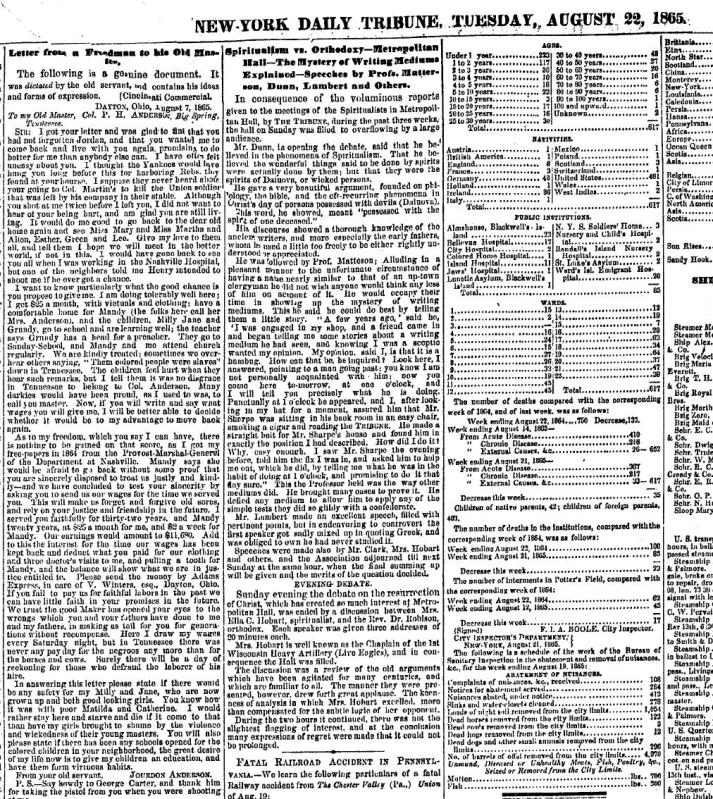
 É conhecido o apreço da leitora por correspondência, pelo que foi uma boa surpresa encontrar a citação desta carta no blogue Âncoras e Nefelibatas e a referência a outro blogue dedicado, precisamente, à divulgação de cartas "merecedoras de uma audiência mais vasta" - Letters of Note -, do qual se transcreveu esta resposta de um homem livre ao seu antigo senhor.


In August of 1865, a Colonel P.H. Anderson of Big Spring, Tennessee, wrote to his former slave, Jourdon Anderson, and requested that he come back to work on his farm. Jourdon — who, since being emancipated, had moved to Ohio, found paid work, and was now supporting his family — responded spectacularly by way of the letter seen below (a letter which, according to newspapers at the time, he dictated).

Rather than quote the numerous highlights in this letter, I'll simply leave you to enjoy it. Do make sure you read to the end.

UPDATE: Head over to Kottke for a brief but lovely little update about the later years of Jourdon and family.

(Source: The Freedmen's Book; Image: A group of escaped slaves in Virginia in 1862, courtesy of the Library of Congress.)
Dayton, Ohio,

August 7, 1865

To My Old Master, Colonel P.H. Anderson, Big Spring, Tennessee

Sir: I got your letter, and was glad to find that you had not forgotten Jourdon, and that you wanted me to come back and live with you again, promising to do better for me than anybody else can. I have often felt uneasy about you. I thought the Yankees would have hung you long before this, for harboring Rebs they found at your house. I suppose they never heard about your going to Colonel Martin's to kill the Union soldier that was left by his company in their stable. Although you shot at me twice before I left you, I did not want to hear of your being hurt, and am glad you are still living. It would do me good to go back to the dear old home again, and see Miss Mary and Miss Martha and Allen, Esther, Green, and Lee. Give my love to them all, and tell them I hope we will meet in the better world, if not in this. I would have gone back to see you all when I was working in the Nashville Hospital, but one of the neighbors told me that Henry intended to shoot me if he ever got a chance.

I want to know particularly what the good chance is you propose to give me. I am doing tolerably well here. I get twenty-five dollars a month, with victuals and clothing; have a comfortable home for Mandy,—the folks call her Mrs. Anderson,—and the children—Milly, Jane, and Grundy—go to school and are learning well. The teacher says Grundy has a head for a preacher. They go to Sunday school, and Mandy and me attend church regularly. We are kindly treated. Sometimes we overhear others saying, "Them colored people were slaves" down in Tennessee. The children feel hurt when they hear such remarks; but I tell them it was no disgrace in Tennessee to belong to Colonel Anderson. Many darkeys would have been proud, as I used to be, to call you master. Now if you will write and say what wages you will give me, I will be better able to decide whether it would be to my advantage to move back again.

As to my freedom, which you say I can have, there is nothing to be gained on that score, as I got my free papers in 1864 from the Provost-Marshal-General of the Department of Nashville. Mandy says she would be afraid to go back without some proof that you were disposed to treat us justly and kindly; and we have concluded to test your sincerity by asking you to send us our wages for the time we served you. This will make us forget and forgive old scores, and rely on your justice and friendship in the future. I served you faithfully for thirty-two years, and Mandy twenty years. At twenty-five dollars a month for me, and two dollars a week for Mandy, our earnings would amount to eleven thousand six hundred and eighty dollars. Add to this the interest for the time our wages have been kept back, and deduct what you paid for our clothing, and three doctor's visits to me, and pulling a tooth for Mandy, and the balance will show what we are in justice entitled to. Please send the money by Adams's Express, in care of V. Winters, Esq., Dayton, Ohio. If you fail to pay us for faithful labors in the past, we can have little faith in your promises in the future. We trust the good Maker has opened your eyes to the wrongs which you and your fathers have done to me and my fathers, in making us toil for you for generations without recompense. Here I draw my wages every Saturday night; but in Tennessee there was never any pay-day for the negroes any more than for the horses and cows. Surely there will be a day of reckoning for those who defraud the laborer of his hire.

In answering this letter, please state if there would be any safety for my Milly and Jane, who are now grown up, and both good-looking girls. You know how it was with poor Matilda and Catherine. I would rather stay here and starve—and die, if it come to that—than have my girls brought to shame by the violence and wickedness of their young masters. You will also please state if there has been any schools opened for the colored children in your neighborhood. The great desire of my life now is to give my children an education, and have them form virtuous habits.

Say howdy to George Carter, and thank him for taking the pistol from you when you were shooting at me.

From your old servant,

Jourdon Anderson.
 

segunda-feira, 5 de novembro de 2012

Apologia do fracasso

T. e os seus títulos sugestivos - "Apologia do fracasso" -, a partir de José Castello, no blogue Literatura na Poltrona. Num balanço da vida, o que se destacaria: a correnteza dos êxitos ou o rosário dos fracassos? É chegada a hora do dito balanço? Stendhal sugere os cinquenta, idade a que ainda não chegou, mas a década caminha para essa fronteira...
 
Até lá, fiquemos na companhia do escritor francês:
 
" Sentei-me nos degraus de San Pietro e aí me deixei ficar uma ou duas horas com esta ideia a trabalhar-me: «Vou fazer cinquenta anos, já era tempo de me conhecer. Quem fui, quem sou eu, na verdade muito embaraçado me sinto em dizê-lo. "
 
"Quem fui eu, então? Não o sei dizer. A que amigo, por mais esclarecido que seja, me será dado perguntá-lo? Nem mesmo o senhor Fior(i) me poderia dar um parecer. A que amigo terei eu dito uma palavra sequer sobre os meus desgostos de amor?
E, dizia eu para comigo nessa manhã, o que há de singular e triste em tudo isto é que o prazer que fruí das minhas vitórias (como eu então, com a cabeça cheia de coisas militares, as designava) não equivale nem a metade do profundo infortúnio que colhi das minhas derrotas."
 
"À noite, ao regressar, bastante entediado, do serão em casa do embaixador, disse para comigo: devia começar a escrever a minha vida, talvez que quando, daqui a uns dois ou três anos, chegar ao fim, consiga saber o que fui, se alegre se triste, se um homem de espírito se um parvo, se um homem de coragem ou um medroso, e, finalmente, feliz ou infeliz, e talvez possa dar o manuscrito a ler a di Fiori.
Sorriu-me essa ideia. Pois sim, mas aquela horrível profusão de Eu e de Mim! Chega para pôr de mau humor o mais benévolo dos leitores. O Eu e o Mim acabariam por ser, com as devidas distâncias, como M. de Chateaubriand, esse rei dos egotistas.
De je mis avec mois tu fais la récidive... (1)
lembro-me deste verso todas as vezes que leio uma página sua.
É verdade que também se pode escrever, usando a terceira pessoa, ele fez, ele disse. Mas então como se há-de testemunhar o que se passa no íntimo, na alma de cada um? É sobretudo a este respeito que gostaria de saber a opinião de di Fiori."
 
 
Stendhal, Vida de Henry Brulard, Porto, Inova, s.d. (tradução de Luiza Neto Jorge e António Ramos Rosa)

As aulas e os textos

A Mensagem não empolga, mas aqui e ali surgem estes poemas, estas palavras cheias de beleza.


Dulce Pontes, "O Infante"


I
 
O INFANTE
 
Deus quer, o homem sonha, a obra nasce.
Deus quis que a terra fosse toda uma,
Que o mar unisse, já não separasse.
Sagrou-te, e foste desvendando a espuma,
 
E a orla branca foi de ilha em continente,
Clareou, correndo, até ao fim do mundo,
E viu-se aterra inteira, de repente,
Surgir, redonda, do azul profundo.
 
Quem te sagrou criou-te português.
Do mar e nós em ti nos deu sinal.
Cumpriu-se o Mar, e o Império se desfez.
Senhor, falta cumprir-se Portugal!
 
 
Fernando Pessoa, Mensagem, Lisboa, Ática, 1979.


domingo, 4 de novembro de 2012

Vox populi

Jeanloup Sieff, "Les petites dalles", 1984


- Até tens coisas giras, mas são muito velhas.
- O quê?!
- Sim. Quantos anos tem esse casaco?
- ...
- Ah! Compraste alguma coisa depois de eu nascer?
- ?!...

sexta-feira, 2 de novembro de 2012

[Água morrente]


Meus olhos apagados,
Vede a agua cahir.
Das beiras dos telhados,
Cahir, sempre cahir.

Das beiras dos telhados,
Cahir, quasi morrer...
Meus olhos apagados,
E cansados de ver.

Meus olhos, afogae-vos
Na vã tristeza ambiente.
Cahi e derramae-vos
Como a agua morrente.

 
Camilo Pessanha, Clepsydra, Lisboa, Relógio d'Água, 1995 (edição crítica de Paulo Franchetti).
 
 
[A beleza, um bálsamo para estes dias cansados.]

quinta-feira, 1 de novembro de 2012

Dia de Finados

MEDITAÇÃO DO DUQUE DE GANDIA SOBRE A MORTE DE ISABEL DE PORTUGAL

Nunca mais
A tua face será pura e limpa e viva
Nem o teu andar como onda fugitiva
Se poderá nos passos do tempo tecer.
E nunca mais darei ao tempo a minha vida.

Nunca mais servirei senhor que possa morrer.
A luz da tarde mostra-me os destroços
Do teu ser. Em breve a podridão
Beberá os teus olhos e os teus ossos
Tomando a tua mão na sua mão.

Nunca mais amarei quem não possa viver
Sempre,
Porque eu amei como se fossem eternos
A glória, a luz e o brilho do teu ser,
Amei-te em verdade e transparência
E nem sequer me resta a tua ausência,
És um rosto de nojo e negação
E eu fecho os olhos para não te ver.

Nunca mais servirei senhor que possa morrer.

 
Sophia de Mello Breyner Andresen, Obra Poética II, Lisboa, Caminho, 1995.